
Sign up here if you would like to subscribe to our newsletters.
Spring 2025
Gardening4Health Newsletter
Edition 5 Spring 2025

We’re publishing this, the latest Gardening4Health Newsletter on none other than World Therapeutic Horticulture Day.
The 18th May each year is hoped to become a worldwide celebration that aims to raise awareness of the practice of therapeutic horticulture, the many benefits it brings to communities around the world, and the amazing people who work in the field. For more information see the WTHD Page on theTrellis website.
Symposium at Tuppenny Barn
It’s not long to go now before our next Symposium.

We’re back at Tuppenny Barn on Monday 30th June for a day which promises to be both educational and inspirational.
Ideal for anyone interested in Therapeutic Horticulture or Green Therapies, the day will focus both on STH in general, but we have a brilliant range of talks on STH
For more information and booking click here
The Little Yellow Book of Gardens and Health

Here’s a plug for this the latest, and better-than-ever edition of the @nationalgardenscheme annual Little Yellow Book of Gardens and Health.
It’s absolutely jam-packed with knowledge, wisdom, and stories from an amazing range of sources. Two hundred pages of inspiration and encouragement all about the many ways that gardens and gardening can help with our health and wellbeing.
It’s completely free, and downloadable here.
Cultivating Wellbeing App
If you haven’t already seen it, I recommend you have a look at this new App. It’s been developed by Thrive and is aimed at people who may not be able to sign up for a formal Therapeutic Horticulture programme, for whatever reason, but still want to have some guidance as they connect with nature and get gardening for their own wellbeing.
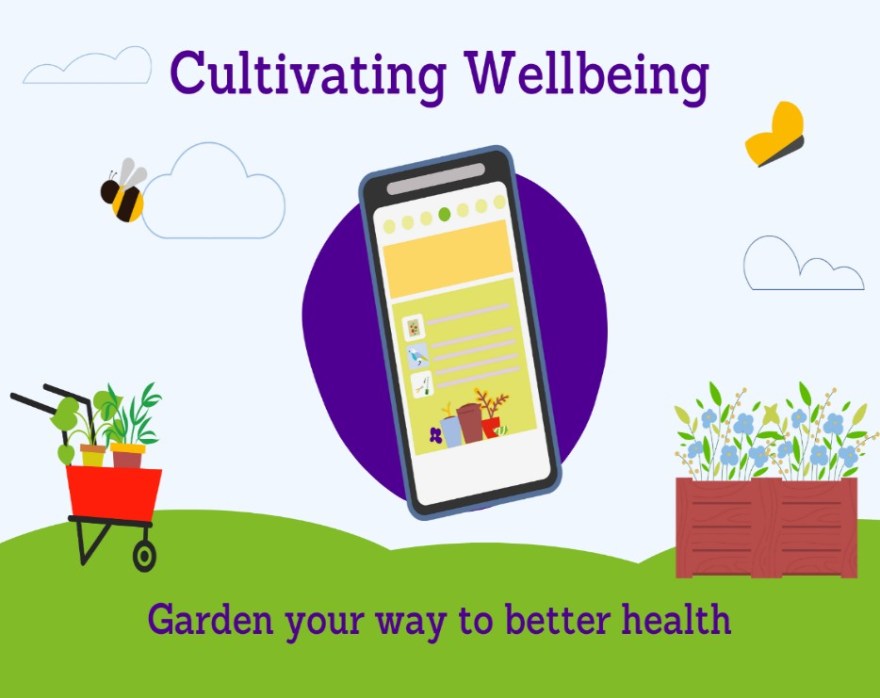
Available from the Apple App Store and Google Play Store, it’s the first gardening for health and wellbeing app on the digital market.
You don’t need a big garden, or indeed any garden at all. A patio, balcony, or even windowsill inside will allow you to take part in the guided activities, and it’s suitable for any level of gardening experience, from novices to skilled gardeners. Moreover, there are plenty of activities that need little or no equipment, so you don’t even need an extensive gardening toolkit.
If you would like to know more about Cultivating Wellbeing – Read the app FAQs on the Thrive website
Draft Practice Standards for Social and Therapeutic Horticulture Practitioners
Work continues apace for the progression towards a UK Wide Association of STH, led by Thrive and Trellis.
“We are pleased to let you know that we have completed work on draft Practice Standards. These standards are designed to articulate how STH Practitioners go about their work and in doing so enable registrants to meet their commitment to upholding the ASTH Code of Ethics.
The standards will serve as one of the key guiding documents for those joining the accredited register, which will be maintained by the Association for Social and Therapeutic Horticulture. The new Practice Standards have been developed by a working party made up of Professional Development Forum volunteers and then reviewed by the ASTH operational group. You can find it here. The next stage is to gain your input, please take a moment to let us know your thoughts by completing this survey.”
Links to the Standards and Survey can be found here.
Horatio’s Garden Sheffield & East is Now Open!
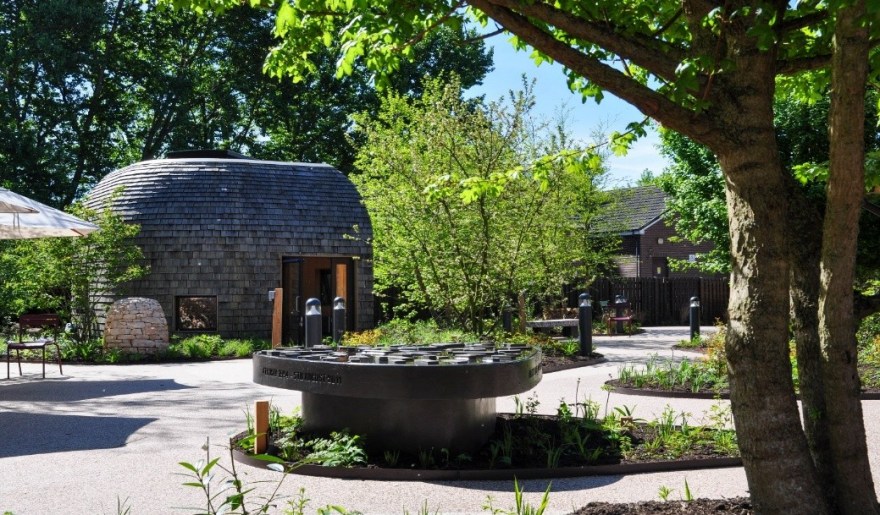
Exactly two years after the garden began its life at RHS Chelsea Flower Show, Horatio’s Garden Sheffield & East is now open. Located at the second largest spinal injury centre in the UK, the garden supports an extensive geographical area from the West Midlands to East Anglia, South Yorkshire to Lincolnshire. More than 360 in-patients, their family and friends, thousands of outpatients, as well as over 250 NHS staff looking after them, benefit from it every year.
Designed by Charlotte Harris and Hugo Bugg of Harris Bugg Studio, who also created the charity’s award-winning Chelsea garden, and inspired by the history, geography and industry of its Yorkshire home, the garden was built by Sheffield-based contractors RLX Construction and project managed by Gleeds.
The garden is cared for by Head Gardener Ruth Calder, a RBG Kew graduate who has worked in heritage and botanic gardens, community horticulture projects, and as a freelance planting designer and consultant. Ruth is supported by part-time Garden Administrator Becky Silwa Webb and a fantastic team of volunteers.
The Growing Well Garden
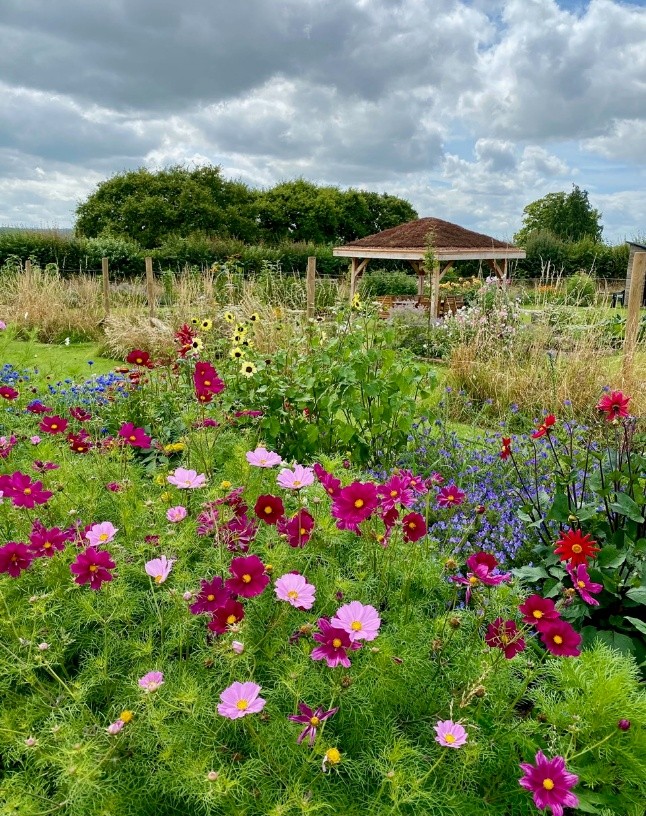
We’re delighted that Dr Susan Taheri has joined Gardening4Health as a Trustee. Many of you may know of her work setting up a Therapy Garden adjacent to the GP Practice where she works, in Devon. Here she talks about the journey so far:
“The idea for Growing Well Garden came about because as a GP I felt so frustrated at feeling like I was too far ‘downstream’ from many of the causes of my patients’ health issues. For example, whilst we know that loneliness and isolation carry an increased risk for physical and mental health problems, there was little I could do to help. As someone who loves gardening and recognises the huge benefits for myself, I started to wonder about what might happen if I met my patients in a garden rather than a consulting room.
For some time I’d been eyeing up a redundant area of field adjacent to the surgery which was part of the site purchased ten years previously for our new-build premises. Unfortunately with work commitments there just didn’t seem the headspace or time to get underway. That all changed in early 2022 when I made a decision to leave my Partnership and take a sabbatical. Having secured a modest sum of set-up funding from the local Primary Care Network (PCN) of local GP practices, we were able to get underway at the end of that January.
The result three years later is a modest allotment style plot with raised beds, a couple of sheds, a central open-sided structure with a green roof and a large poly-tunnel. The latter was funded through a National Garden Scheme Community Garden Award and provides us with a sheltered place to gather, grow and, perhaps most importantly, to connect with each other.
With the help of volunteers we started advertising and opening for drop in sessions in spring 2023. Six months later I managed to persuade the PCN to release some of their centrally allocated ‘Social Prescribing’ budget to fund the role of a Garden Link-Worker. We hit the jackpot when my colleague Emma, a former NHS midwife with thirty years of experience came forward. She was embarking on a career change in horticulture, shared many of my frustrations around the way the health system worked and was passionate about the idea of using the garden and plants to help people.
These days we are now able to offer one-to-one sessions and group work alongside the drop in sessions. Trying to do something different and new within the primary care system has not been without its challenges and we continue to do our best to negotiate these as they arise. We don’t currently have any long-term funding but at the moment we have everything that we need to work.
Now I can sit in my surgery and prescribe my patients time in Growing Well Garden and that’s where I can be found every Tuesday morning, a much happier doctor, enjoying a taste of my own medicine.”
Freedom From Torture Garden
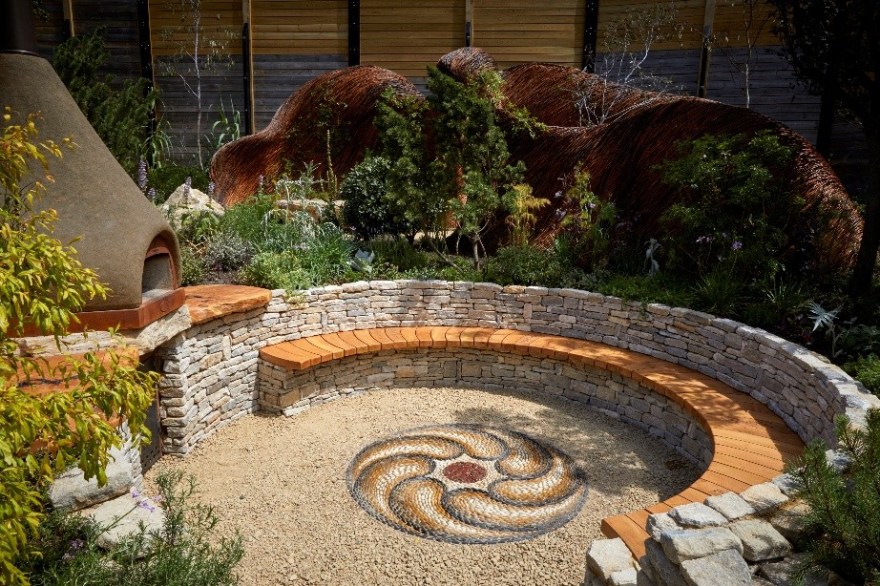
You may rememeber last year we told you about the first Chelsea show garden to incorporate a space for Therapeutic Horticulture.
The garden was designed by Emma O’Connell Garden Design and Senseless Acts of Beauty for the charity ‘Freedom From Torture’ (FFT) and supported by Project Giving Back.
This June it will be open to the public for the first time as part of the London Open Parks & Gardens Event.
“FFT has long recognised the hugely positive impact of horticultural therapy as a powerful tool to empower trauma survivors, their horticultural therapy sessions seek to harness the physical, social and psychological benefits of being in and work with nature and the outdoors. The new, purpose-built therapy garden provide a safe and immersive space to connect with nature and the outdoors and to learn new skills, and to form new relationships and to find purpose. Throughout the garden, sinuous structures woven from organic, renewable willow provide stopping places for individuals to sit: embraced by the willow, and sheltered from the wind. These spaces create moments for individual reflection, one-on-one talking sessions, privacy and security.
FFT also run a Bread Group using the therapeutic process of bread-making to reduce stress and anxiety: the mindful, tactile nature of kneading the dough, recalling home through flavours and smells, using all five sense to engage with surroundings, and having the chance to share food and share stories. The new garden provides a whole new environment to compliment the bread group therapy. It enables the survivors to pick the herbs and other edimentals growing the garden so that they can flavour their bread with tastes from their homelands, such as Foeniculum, Nigella and Thymus. The outside clay bread oven allows survivors to bake the bread outdoors immersed in nature, and to be able to sit in the safety of the enclosing, sheltered circular seating in the sunken garden to break their bread, and tell their stories.
The garden has become a truly successful therapeutic space and treasured place for survivors, staff and volunteers, and is used daily.”
Our Tonbridge Therapy Garden Project
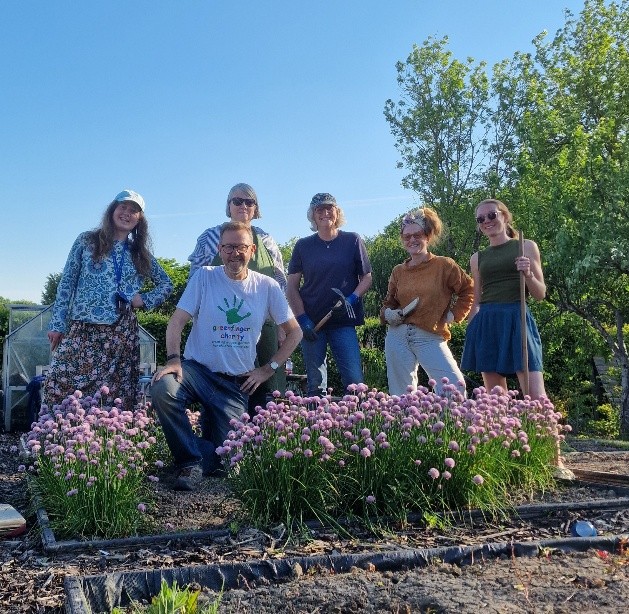
We continue to work hard to raise desperately needed money so that we can reopen our project in Tonbridge.
In the meantime, huge thanks go out to the intrepid band of volunteers who helped weed the allotment space: it had become pretty overgrown!
And also huge thanks go out to all our donors – including the London Gardens Network – who raised £750 for us as well as two other charities at their Spring Seminar. Support of this kind is so appreciated, and will enable us to build on our platform and give us real momentum as we move forward with our plans.
All Change at the National Garden Scheme
Lastly, we couldn’t complete this Newsletter without a special mention of our founder, Richard Claxton, and his new appointment as CEO of the NGS.

Quoted in the NGS’s Press release Gardening4Health’s founder
“I’m absolutely thrilled to be appointed as the new Chief Executive of the National Garden Scheme. As a charity it’s the perfect fit for me: combining beautiful gardens and the wonderful generosity of their owners opening their private sanctuaries for us all to enjoy. As garden visitors, we join in with this generosity and together we all make a huge and valuable contribution to a range of brilliant causes across the country, with supporting nurses and improving healthcare at the forefront.
The National Garden Scheme is a champion of the impact that gardens and gardening can have directly on people’s health, which is a cause very close to my heart.
It’s a huge challenge and one I am looking forward to. I’m all too aware of the shoes I have to fill; for fifteen years George Plumptre has led the charity from strength to strength, raising its profile and the level of its donations to new heights – and maintaining its impact in spite of garden closures in the pandemic. I look forward to building on this incredible foundation. The National Garden Scheme’s work underpins the vital links between gardens, generosity, health, and community – all of which we need now more than ever. I couldn’t be prouder to contribute to this amazing charity.”
To download the PDF of this latest newsletter click below:
Archive:
Winter 2025
Autumn 2024
Summer 2024
Spring 2024
 Gardening4Health
Leave a comment